Thursday, September 12, 2013

Dr. Don Warne nominated as a White House Champion of Change for Public Health!

From http://www.whitehouse.gov/champions

Congratulations Dr. Warne!
 
The best ideas come from the American people. Everyone has a story to tell, everyone has a part to play.

All across the country, ordinary Americans are doing extraordinary things in their communities to out-innovate, out-educate, and out-build the rest of the world. Every week, we will invite these Champions of Change to the White House to share their ideas to win the future.
 
The blog of Champions can be viewed here: http://www.whitehouse.gov/champions/blog 

Sunday, September 1, 2013

Argus Leader- Insulin maker to fight diabetes on reservation

I worked on this project with Novo Nordisk and the Rosebud Sioux Tribe. The full article can be found here.

Article written by Steve Young:
August 25, 2013

The dark patches on their skin tell a troubling tale of life and poverty on the Rosebud Indian Reservation.

Doctors call them acanthosis nigricans, and they mark hundreds of Lakota children from places such as Rosebud and Milk’s Camp and Two Strike whose bodies are resisting insulin and teetering on the edge of diabetes.

Left untreated, many of those children could become part of a startling statistic — death from Type 2 diabetes on the reservation is five to six times the national average and worse than anyplace else in America.

But a Denmark-based company called Novo Nordisk is working to reverse that possibility with a $3 million gift to the Rosebud Sioux. The money is paying for a 13,000-square-foot wellness center, for a mobile clinic to bring health care to the most desolate corners of the reservation and for diabetes education.

“I applaud them,” said Dr. Donald Warne, former head of Sanford Health’s Office of Native American Health and now director of North Dakota State University’s master of public health program. “No other private sector entities have stepped forward onto the reservations to try to do something like this in a positive direction.”

The pharmaceutical giant Novo Nordisk is the world’s largest producer of insulin. It’s also heavily involved in nonprofit work, reaching out internationally to underserved communities.

Visit to the reservation
It happened upon Rosebud after one of its medical leaders visited western South Dakota in 2010.

Curt Oltmans, general counsel for Novo Nordisk, grew up in Norfolk, Neb., and would drive across the reservation in a meat delivery truck 30 years ago. He’s seen the challenges of life there, and now knowing the interest within the company for helping this reservation, he moved into a project leadership role.

Initially, the company met with the tribe’s diabetes prevention staff and gathered data about the prevalence of the disease on the reservation and the needs. Then they talked with tribal council members about administration and financing.

The council bought in during spring 2011. Before that, Novo Nordisk set up a $3 million trust it called the Native American Health Initiative. From that money, it was decided to spend a little more than $2 million on a new and expanded wellness center, and another $400,000 on a mobile unit that eventually could provide billable health care services relating to diabetes treatment.

'Only for diabetes prevention'
“The only thing we’ve asked the tribe to do is use this wellness center and mobile unit only for diabetes prevention and education. Those are the only strings attached,” Oltmans said.

The dedication of the wellness center near the Indian Health Service hospital in Rosebud was Friday. The possibilities for this expanded space are immense, said Connie Brushbreaker, director of the tribe’s diabetes

Fitness classes now can be held in the wellness building where space was too tight before, she said. There is dedicated education space, a kitchen to teach more healthful cooking, classroom space and Internet connectivity that will allow for distance learning, and office space.

“There will be three or four very basic exam rooms,” Oltmans said. “It’s hard for people to get physicals through Indian Health Service. We’re trying to get physicians into the center periodically to do that.”

More than a one-time thing
Mobile units that roamed the reservation in the past were there mostly to screen for heart disease, cancer and other ailments, but offered no real primary care or medical services, Warne said.

“With all the other units that came through the reservation, it was a one-time thing,” Brushbreaker said. “I heard a lot of complaints about no follow-up,” Brushbreaker said. “With our diabetes mobile unit, we’ll be able to go out continually, meet with patients and continue education. We’re not going to a community one time and that will be it.”

This unit will do X-rays, screenings and provide other services. If the program can gain recognition from external bodies such as the American Association of Diabetes Educators, it “can charge back for time, services and help them generate some income,” Oltmans said.

Beyond its capital investments, Novo Nordisk will cover operating costs for a while, Oltmans said. But getting the program to the point where it can bill Medicaid, Medicare and other insurance for services is critical.

Tribe to play key role in staffing
So is the tribe’s participation. So, for example, while Novo Nordisk will start out paying for the maintenance and insurance on the mobile unit, the tribe will provide staffing for it and the wellness center.

The effort’s third leg is the training and certification of diabetes education and prevention specialists to work with tribal members, Oltmans said. Their jobs will be convincing the people that Type 2 diabetes is preventable and that a diagnosis does not have to be a death sentence.

At 90 percent completion, the wellness center should be fully operational by mid-October, Brushbreaker said. “And the mobile unit,” she said, “will hopefully be operating much sooner than that.”

Oltmans said his company will “be very disappointed” if people aren’t going to the wellness center and the reservation’s diabetes numbers don’t drop dramatically.

Warne and Brushbreaker don’t believe that will be a problem.

“Their existing wellness center already does a very good job of tracking the number of people using their services and a good job of tracking health measures as far as managing or preventing diabetes,” Warne said. “My sense of it is they will see a dramatic increase in wellness center utilization because they have more capacity. Because of that, more physical activity should translate into less diabetes and less complications.”


MPH Student at Health Board

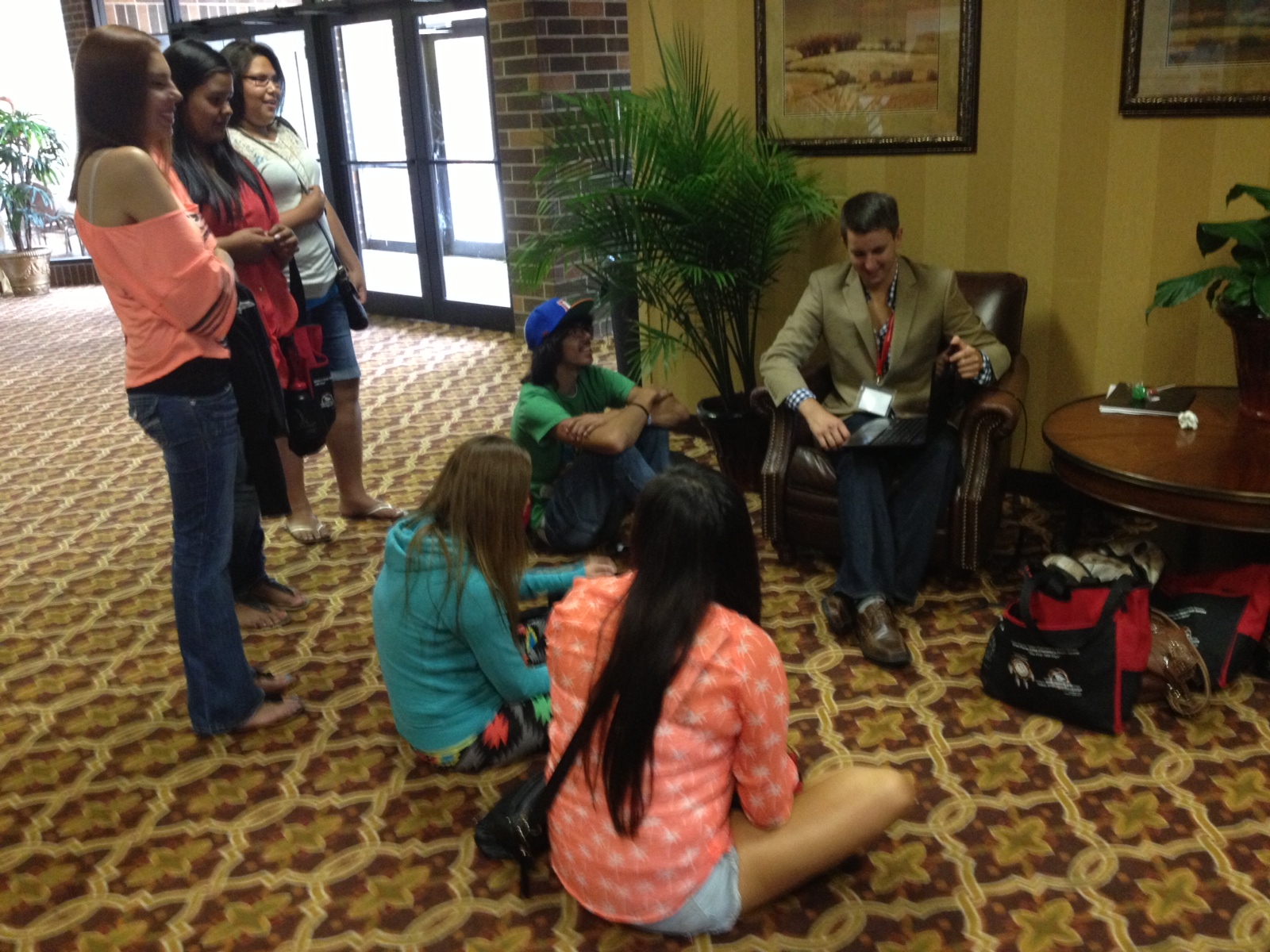
Impromptu training by MPH student Nicki Cain for students at the Health Board meeting in Aberdeen.

Sunday, August 25, 2013

New Student Orientation

19 of our 25 incoming students for the Fall 2013 semester were photographed during orientation on Friday August 23rd.

Meeting with Senator Heidi Heitkamp

I had a great meeting with US Senator Heidi Heitkamp regrading American Indian health policy and the NDSU MPH Program!

Wednesday, August 21, 2013

Tribal Chairmen's Health Summit Looks at First 1,000 Days

The Great Plains Tribal Chairmen’s Health Board is focusing on giving babies a good start. The board serves as an advocate for tribes in South Dakota, North Dakota, Iowa, and Nebraska. At this year’s Tribal Chairmen’s Health Summit, leaders and health officials came together to discuss how to prevent and mitigate stress in the first one thousand days of child’s life.  
Leaders at the annual health summit had a lot to discuss during the two days of meetings. Officials say Native Americans face many health disparities…higher rates of diseases like diabetes, cancer, and heart disease, as well as higher rates of risk factors and unintentional injuries. That’s why this year, they’ve chosen to focus on improving health right from the very beginning, by giving babies a healthier start in life. Doctor David Willis is with the Maternal and Child Health Bureau with the US Department of Health and Human Services’ Health Resources and Services Administration. He says the first few days of a child’s life are extremely important.

“We’re talking about the fundamental foundations of human development and how critically important the first thousand days of a baby’s young life is to creating the strengths for health, education, child wellness, school readiness, mental health, and spiritual wellbeing,” Willis says. “So the first thousand days are the period with which those skills are embedded into the very essence of who the person becomes.”

Willis says in some ways, the first thousand days for a child growing up in Indian country are put at a greater risk than those of children in other areas.

“Solely because of the challenges of the previous generation of now young parents who’ve had both the historical trauma or their own challenges of trauma that currently exist for them or simply the stress of hard living,” Willis says. “This is not true of all families but certainly for a large majority of families that we know who have health disparities or issues of stress, trauma, substance abuse and alcoholism issues.”

That stress and trauma is known as an adverse childhood experience. Doctor Donald Warne is the Director of the Master of Public Health program at North Dakota State University. He says children who have to deal with these adverse experiences often have poorer health as adults.

“In other populations around the country outside of South Dakota where they’ve done this particular study they see that the actual number of adverse childhood experiences correlates with things like depression, substance abuse, suicide attempts,” Warne says. “But in addition to that it correlates also with rates of cancer, rates of diabetes, rates of heart disease. So I think there’s an emerging science looking at the importance of the conditions that children grow up in and how that links to health in adulthood.”

Speakers at the summit point out that many parents in Indian country are raising children while still trying to heal from their own adverse childhood experiences. Jerilyn LeBeau Church is the Chief Executive Officer for the Great Plains Tribal Chairmen’s Health Board. She says it’s important to be aware of the historical experiences and the wounds that tribal members carry with them.

“There’s this cycle of healing that needs to take place,” LeBeau Church says. “And really we can look to evidence based protocols, but we also need to look to our own culture. We need to go back to our own ways of praying and our own traditional values that our ancestors left to us. And that in itself can bring a tremendous amount of healing to our communities.”
LeBeau Church says in order to bring healing and help the next generation of babies, states, tribes, and different programs and agencies are going to have to work together. It’s a theme that ran throughout the conference: no single agency can solve all of the problems affecting health in Indian country. Leaders say it takes a whole community working together to raise a healthy child.
And officials are hopeful. David Willis with the Maternal and Child Health Bureau says every new baby provides an opportunity for change.
“So our hope is always that despite challenges of the past, that can be managed effectively and directly, intentionally to help the next generation of young children to be healthy and thrive and develop,” Willis says. “And we know that work can happen by intention, by how a community surrounds families of young children, how stories of trauma and challenges are brought into meaningful dialogues and support so that people can begin to find a new way of being present with their new babies and not having the past invade the future.”
Willis says babies are resilient and can thrive if they are surrounded by people who are hopeful and committed to help the next generation succeed. Officials with the Tribal Chairmen’s Health Board hope that leaders who attended the summit are now armed with more information to help create communities full people determined to give babies the best possible start.

Tuesday, August 13, 2013

Official endorsement of NDSU MPH by NIHB

The National Indian Health Board has officially endorsed the American Indian Public Health Track of the Master of Public Health Program in Resolution 13-02.

The National Indian Health Board (NIHB) is committed to advocating on behalf of all Tribal Governments and American Indian/Alaska Natives while: promoting healthy practices; preventing diseases and injuries; providing basic resources and infrastructure to Tribes; and researching and developing tribal, local, state, and national health policy.